Cabinet Factory
Oct.21, 2026
Cabinet manufacturing combines solid wood cutting, CNC routing, profile machining, sanding and assembly. Each process generates different amounts and types of dust, while customized production schedules often require machines to start and stop at different times.
A conventional dust extraction system that operates at full capacity regardless of production demand may consume unnecessary energy and place additional operating hours on fans and other components. Fine sanding dust can also migrate into surface preparation and coating areas, increasing the risk of finish contamination and rework.
LUFMAX provides zoned intelligent dust extraction systems for cabinetry workshops. By coordinating dust collection across cutting, sanding and other production areas, the system can match extraction operation to actual demand while supporting cleaner production environments and more flexible workshop management.
Industry Challenges:
American-style cabinetry production involves a complex mix of solid wood cutting, intricate profile sanding, and multi-stage finishing. In such environments, fine sanding dust is the primary enemy; if not contained, it drifts into coating areas, causing surface defects or "specks" on high-end lacquer finishes, which leads to costly rework. Furthermore, the custom nature of cabinetry means machines are switched on and off frequently. Traditional extraction systems often operate at full capacity regardless of the load, resulting in massive energy waste and unnecessary mechanical strain.
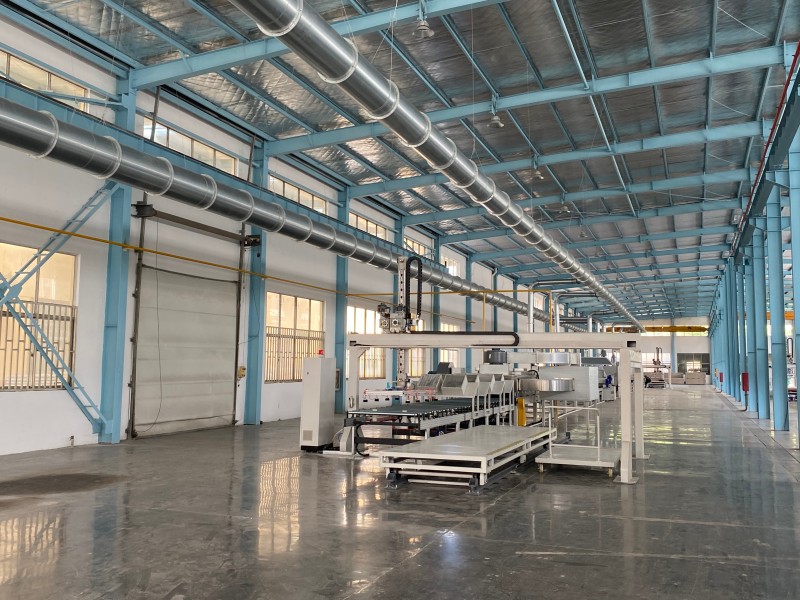
The LUFMAX Solution:
LUFMAX provides a Zoned Intelligent Extraction System tailored for cabinetry workshops. By implementing independent pressure-sensing controls across cutting, sanding, and assembly areas, we ensure a pristine environment for surface treatment and eliminate cross-contamination at the source. Our integrated VFD (Variable Frequency Drive) modules precisely match airflow to real-time demand—whether running a single edge-bander or the entire plant—minimizing operational costs without sacrificing performance. With a compact, modular footprint, LUFMAX not only meets the rigorous standards of American cabinetry craftsmanship but also empowers factories to transition toward lean, green, and high-efficiency manufacturing.
How the Zoned Intelligent Extraction System Works
1. Independent Extraction Zones
Cutting, sanding and other dust-generating operations can be organized into separate extraction zones according to the workshop layout and process requirements. Each zone is assessed based on its connected machines, dust generation and operating schedule.
This arrangement supports more flexible extraction management when cabinet production involves frequent product changes or varying machine utilization.
2. Pressure-Sensing Control
Independent pressure-sensing controls can be used to monitor operating conditions across designated zones. The control strategy can then respond to changes in extraction demand, helping maintain the required airflow conditions as machines are switched on or off.
Sensor placement, control logic and pressure setpoints should be established during engineering design according to the duct network and machine requirements.
3. Variable-Frequency Drive Control
Variable-frequency drives (VFDs) adjust fan operation according to the system's control requirements. Instead of relying solely on fixed-speed operation, the system can regulate fan speed or operating capacity as extraction demand changes.
When properly engineered, demand-based control can reduce unnecessary fan energy consumption during partial-load operation. Actual savings depend on the fan characteristics, pressure requirements, operating hours and production profile.
4. Centralized Filtration and Dust Discharge
The extraction network transports collected dust to a centralized filtration and discharge arrangement. Filter selection, cleaning method and dust handling capacity should reflect the quantity and characteristics of the collected material.
The configuration can be evaluated according to the factory's available installation space, maintenance requirements and production continuity needs.
Why Use Zoned Intelligent Extraction in Cabinet Manufacturing?
| System Feature | Practical Value |
|---|---|
| Zoned extraction management | Allows different production areas to operate according to their individual requirements |
| Pressure-sensing controls | Supports demand-based extraction management across designated zones |
| VFD fan regulation | Helps reduce unnecessary fan operation when demand decreases |
| Centralized dust collection | Coordinates dust handling from multiple connected machines |
| Modular system planning | Allows the layout to be adapted to workshop space and production requirements |
| Maintenance-oriented design | Supports planned inspection of fans, filters, sensors and dust discharge components |
These benefits depend on suitable system sizing, correct installation, effective machine-level dust capture and appropriate control settings.
Reducing Dust Migration into Cabinet Finishing Areas
Surface quality is particularly important in cabinet manufacturing, where visible defects may result in additional sanding, recoating or other rework. Fine sanding dust that escapes its collection point can settle on prepared surfaces or migrate toward coating areas.
A zoned dust extraction strategy can help manage this risk through several measures:
-
Capture dust close to the cutting, routing and sanding source.
-
Evaluate airflow direction and separation between dusty machining areas and cleaner finishing spaces.
-
Balance extraction demand across connected machines and production zones.
-
Maintain filters, ductwork and collection points to prevent avoidable losses in extraction performance.
-
Coordinate dust extraction with the workshop's ventilation and finishing arrangements.
Dust extraction alone does not guarantee a defect-free coating process. Surface preparation, material handling, housekeeping, ventilation and coating procedures also affect final finish quality.
Customized Dust Extraction Solutions for Cabinet Factories
LUFMAX can evaluate a zoned extraction configuration based on the following project information.
| Design Parameter | Information Required |
|---|---|
| Production equipment | CNC routers, panel saws, profile sanders, edge banders and other connected machines |
| Extraction zones | Number of zones, machine locations and operating relationships |
| Machine operating schedule | Simultaneous operation, production shifts and frequency of machine changes |
| Airflow demand | Required extraction airflow and pressure at each machine |
| Control requirements | Pressure sensing, VFD regulation and preferred control strategy |
| Workshop layout | Building dimensions, ceiling height, equipment arrangement and duct routing |
| Filtration requirements | Dust characteristics, expected loading and suitable filter configuration |
| Dust discharge | Collection method, storage capacity and waste-handling arrangements |
| Safety requirements | Combustible-dust assessment and applicable fire and explosion protection measures |
| Future expansion | Planned additional machines, production zones or changes to the manufacturing layout |
These details allow the engineering team to assess the required extraction capacity, duct network, filtration equipment and control configuration.
Dust Extraction System for Cabinetry Workshops: Contact LUFMAX
LUFMAX provides centralized dust extraction systems for woodworking and furniture manufacturing facilities, including cabinet workshops with multiple dust-generating machines and changing production demands.
Whether you are planning a new cabinetry workshop or upgrading an existing extraction network, LUFMAX can assess your machinery, production zones, airflow requirements and workshop layout to develop a suitable system proposal.
-
Previous:
-
Next:
Latest News
-
Nov.11, 2026
Dry Spray Booth vs. Water Wash Booth: Which Costs Less?
A dry spray booth utilizes dry filter media to capture overspray, while a water wash booth uses a water-based system to remove contaminants from the air and surfaces. Both are designed for painting applications but differ significantly in operational methods and environmental impact.
-
Nov.10, 2026
Dry Filter Spray Booth Maintenance Guide for Furniture Factories
In furniture factories, maintaining a dry filter spray booth is crucial for ensuring a clean working environment and high-quality finishes on products. A well-maintained spray booth not only enhances the application of finishes but also improves safety and compliance with environmental regulations. This guide provides actionable steps to effectively maintain dry filter spray booths, ensuring
-
Nov.09, 2026
How to Choose a Cabinet Dust Collector for Furniture Sanding
Before selecting a cabinet dust collector, evaluate the size of your workshop. Smaller spaces may need more compact models while larger areas can accommodate larger systems. Measure the square footage and assess the layout for optimal positioning.