Large Furniture Factory
Oct.21, 2026
This project features a sophisticated centralized dust collection system designed for a high-capacity facility producing both solid wood and panel-based furniture. The core design philosophy focuses on maximizing operational efficiency while ensuring a sustainable equipment life-cycle.
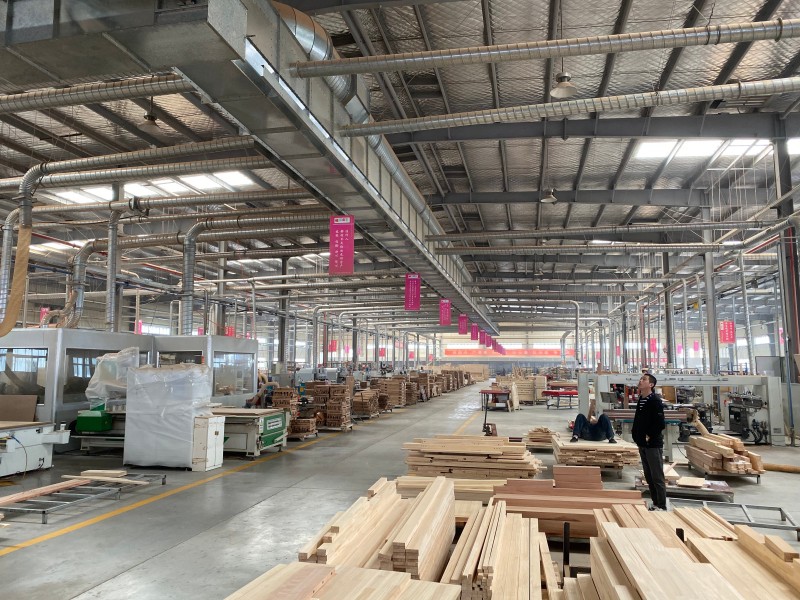
Smart Efficiency: VFD (Variable Frequency Drive) adjusts suction power in real-time based on active machines. Saves 35% on energy.
Modular Reliability: Multiple fan array ensures zero downtime. If one fan stops, the factory keeps running.
Hybrid Filtration: Specialized media captures both heavy wood chips and ultra-fine panel dust.
Life-cycle Protection: Built-in predictive maintenance sensors and ATEX-certified explosion protection to extend system life and ensure safety.
|
Key Metrics |
Specifications |
|
Project Scale |
Annual capacity: 60,000 sets |
|
Total Airflow |
120,000 $m^3/h$ |
|
Power System |
132 kW (Equipped with VFD Intelligent Control) |
|
Emission Level |
$< 5mg/m^3$ (Exceeding EU Standards) |
Dust Collection Challenges in Large Furniture Factories
A large furniture production facility may operate several machine types simultaneously, with each process generating different dust and chip characteristics. The extraction system must account for both individual machine requirements and the combined demand of the production network.
| Production Process | Dust Collection Challenge | System Design Consideration |
|---|---|---|
| Solid wood sawing and planing | Large wood chips, shavings and sawdust | Suitable duct dimensions and reliable chip transport |
| CNC machining and routing | High-volume chip generation and fine airborne particles | Machine-level extraction connections and sufficient airflow |
| Panel sawing and drilling | Dust generated across multiple processing stations | Coordinated branch ducts and airflow distribution |
| Edge banding | Fine particles from trimming and finishing operations | Localized collection at dust-generating points |
| Sanding and surface preparation | Fine dust that can spread into surrounding areas | Appropriate filtration and effective source capture |
| Multiple production lines | Variable extraction demand as machines start and stop | Demand-based airflow regulation and fan capacity management |
The total number of machines alone does not determine the required system capacity. Machine specifications, simultaneous operating conditions, duct resistance and the characteristics of the generated dust must also be evaluated.
LUFMAX Centralized Dust Collection System Configuration
1. Machine-Level Dust Capture
Each connected machine requires an extraction arrangement suited to its dust outlets and operating conditions. Extraction hoods, machine ports and branch connections collect dust close to the point of generation.
For factories processing both solid wood and engineered panels, the extraction network should account for differences between heavier chips, shavings and finer sanding dust.
2. Engineered Ductwork Network
The ductwork transports collected material from individual production stations to the central filtration equipment. Main ducts, branch connections, valves and routing are designed around the factory layout and the required airflow at each machine.
Proper duct sizing and airflow balancing help reduce the risk of inadequate suction, excessive resistance and dust accumulation in the conveying network.
3. Centralized Filtration
The filtration unit separates collected dust from the conveying air. Depending on the application, the system can incorporate suitable pre-separation and baghouse or cartridge filtration configurations.
Filter media, cleaning methods and filtration capacity should be selected according to the dust characteristics, expected loading, maintenance requirements and applicable emission limits.
4. Modular Multi-Fan System
LUFMAX centralized dust collection systems can use a modular multi-fan arrangement to support changing production demand. The control system can activate the required fan modules according to the operating load, rather than relying exclusively on a single fan running continuously at full capacity.
This approach supports demand-based operation and allows individual fan modules to be maintained independently, subject to the system configuration and operating requirements.
5. Intelligent Airflow Regulation
A centralized control system can coordinate fan operation and airflow regulation across connected production zones. Pressure monitoring and suitable control valves help manage differences in extraction demand between machines.
The control strategy should be developed around the actual machine operating schedule, system resistance and required extraction conditions.
6. Automated Dust Discharge
Collected dust and chips must be removed from the filtration equipment and transferred to an appropriate storage or handling arrangement. Depending on the production scale and system design, this may include hoppers, rotary valves, collection bins or conveying equipment.
Dust discharge capacity should be matched to the expected waste volume to avoid accumulation that could interfere with continuous operation.
Why Use a Centralized Dust Collection System for a Large Furniture Factory?
| System Feature | Operational Value |
|---|---|
| Multi-machine extraction | Connects multiple production stations through a coordinated duct network |
| Intelligent fan control | Matches active fan capacity to changing extraction demand |
| Modular fan configuration | Supports staged operation and independent maintenance of fan modules |
| Centralized filtration | Consolidates dust separation and filter maintenance |
| Engineered ductwork | Distributes extraction capacity according to machine requirements |
| Automated dust discharge | Supports organized collection and handling of production waste |
| Expandable system planning | Allows future capacity and layout changes to be considered during system design |
Actual energy consumption, dust collection performance and maintenance requirements depend on equipment sizing, installation quality, operating schedules and the condition of the system.
Centralized Dust Collection vs. Individual Dust Collectors
For a large furniture factory, the choice between centralized extraction and individual collectors depends on production scale, machine arrangement and operating requirements.
| Evaluation Factor | Centralized Dust Collection System | Individual Dust Collectors |
|---|---|---|
| Connected equipment | Multiple machines and production areas | One machine or a small group of machines |
| Ductwork | Shared engineered duct network | Short, dedicated connections |
| Fan control | Can coordinate capacity across connected machines | Usually controlled at the individual unit |
| Maintenance | Centralized access to filtration and dust discharge equipment | Maintenance distributed across separate units |
| Installation planning | Requires system-level airflow calculations and duct design | Generally simpler for isolated applications |
| Suitable application | Large furniture factories and multi-line woodworking facilities | Small workshops or independent machines |
For large facilities with changing machine utilization, a centralized system can simplify dust management and coordinate extraction demand across production zones. Individual collectors may remain suitable for isolated workstations or areas that are not practical to connect to the central network.
Safety and Long-Term Maintenance Considerations
Wood dust and some engineered-panel dusts may present combustible-dust hazards. A centralized extraction system should therefore be designed around the properties of the collected material, potential ignition sources and applicable safety requirements.
| Area | Engineering Consideration |
|---|---|
| Dust hazard assessment | Evaluate the combustible characteristics of the processed material |
| Filtration equipment | Select suitable filter media and cleaning arrangements |
| Ductwork | Review dust transport velocity, deposition risks and inspection access |
| Fan and electrical equipment | Assess suitability for the installation environment and identified hazards |
| Explosion protection | Specify appropriate venting, isolation, suppression or other measures where required |
| Filter maintenance | Monitor pressure drop, filter condition and cleaning performance |
| Dust discharge | Prevent excessive accumulation and ensure reliable waste handling |
| System monitoring | Check airflow, fan operation and control-system performance |
The required protection measures depend on the site-specific risk assessment and applicable regulations. They should be established during engineering design rather than assumed to be standard features of every installation.
Customized Dust Collection Systems for Furniture Factories
LUFMAX evaluates centralized dust collection projects according to the factory's machinery, production requirements and installation conditions.
| Design Parameter | Information Required |
|---|---|
| Factory production | Solid wood furniture, panel furniture or mixed production |
| Connected machinery | CNC routers, saws, planers, moulders, sanders and drilling machines |
| Machine quantities | Number of machines and extraction points |
| Operating schedule | Machines running simultaneously, production shifts and operating hours |
| Airflow requirements | Required airflow and pressure at individual extraction points |
| Ductwork layout | Factory drawings, machine positions, routing and installation height |
| Filtration configuration | Dust characteristics, loading and required filtration performance |
| Fan configuration | Total system demand, operating load and control requirements |
| Dust discharge | Waste volume, storage arrangements and handling method |
| Safety requirements | Dust hazard assessment and applicable protection standards |
| Future expansion | Planned production lines, additional machinery and capacity requirements |
Based on this information, the system can be evaluated for fan capacity, duct sizing, filtration configuration, control logic and dust discharge arrangements.
Request a Centralized Dust Collection System Proposal from LUFMAX
LUFMAX provides centralized dust collection solutions for furniture factories and industrial woodworking facilities requiring coordinated extraction across multiple production lines.
For large-scale furniture manufacturing, system design needs to account for machine operating schedules, airflow distribution, filtration, dust discharge and long-term maintenance. A configuration based on actual production conditions can help avoid both insufficient extraction capacity and unnecessary equipment operation.
Share your factory layout, machine list, operating schedule and dust collection requirements with LUFMAX to discuss a centralized dust collection system tailored to your furniture manufacturing facility.
-
Previous:
Latest News
-
Oct.12, 2026
Cabinet Dust Collector Review: Best Uses and Limitations
Are you a woodworker struggling with airborne dust particles that affect both your health and project quality? Enter the Lufmax cabinet dust collector. This innovative device is designed specifically for woodworking professionals and hobbyists who encounter excessive dust and debris during their activities. By providing a comprehensive solution to dust collection, the Lufmax ensures a cleaner
-
Oct.08, 2026
Pros and Cons of a Dry Spray Booth for Furniture Finishing
In today’s competitive furniture manufacturing landscape, the choice of finishing equipment significantly influences product quality and production efficiency. Many woodworkers and furniture manufacturers face challenges with traditional finishing methods, including prolonged drying times and inconsistent finishes, leading to high defect rates. A dry spray booth presents a solution that could
-
Sep.28, 2026
What Is a Water Wash Paint Booth and How Does It Work?
A water wash paint booth is an industrial system designed for the efficient and eco-friendly painting of various surfaces, primarily used in the automotive and manufacturing industries. Unlike traditional paint booths that rely on chemical solvents, a water wash paint booth utilizes water as the primary medium for capturing overspray and contaminants, ensuring a cleaner environment and higher