Panel Furniture Factory
Oct.21, 2026
Large-scale automated panel furniture factories often struggle with the massive amounts of fine dust generated by high-speed CNC centers and automatic edge banding lines. If the extraction pressure is insufficient, dust accumulates on precision rails and sensors, triggering equipment alarms and costly downtime. Moreover, conventional systems lack intelligent sensing to adjust airflow based on line switching, leading to massive energy waste during idling. In a high-tempo production environment, any manual cleaning or system failure creates a domino effect, delaying entire order schedules.
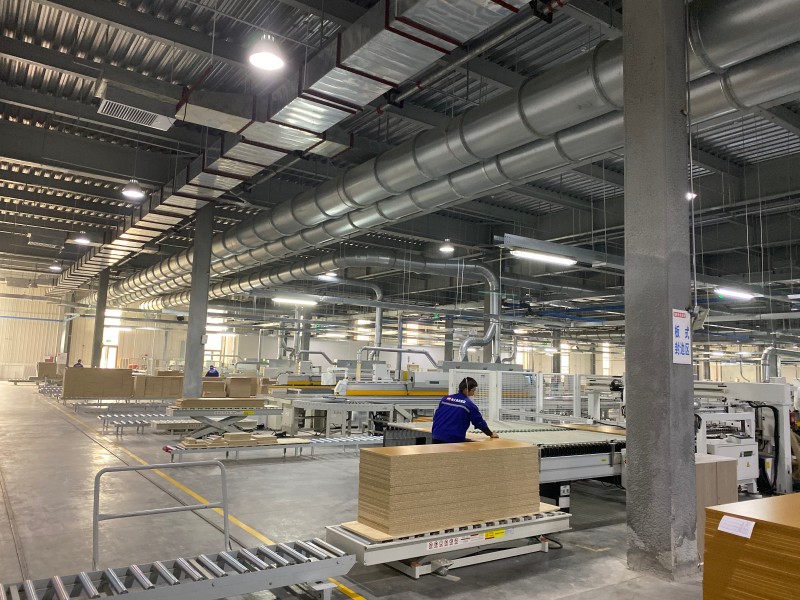
LUFMAX delivers a seamless solution by integrating smart bus-control technology directly into your automated production flow. Our adaptive VFD systems ensure optimal negative pressure for every machine, significantly extending the lifespan of precision spindles and sensors. Equipped with continuous industrial pulse-jet filtration, our systems support 24/7 non-stop operation, maintaining peak suction power even under maximum production loads. By enabling unmanned operation and high-efficiency fan matrices, LUFMAX not only ensures flawless cleaning for edge banding and drilling processes but also provides a robust, zero-downtime foundation for continuous large-scale manufacturing.
Dust Collection Challenges in Panel Furniture Factories
Different production processes generate different types and quantities of dust. A suitable dust extraction system must account for these differences when determining airflow, collection points, duct dimensions and filtration requirements.
| Production Process | Dust and Waste Generated | Dust Extraction Considerations |
|---|---|---|
| CNC cutting and routing | Fine wood particles, panel dust and chips | Machine enclosure, extraction ports and sufficient airflow at the cutting point |
| Panel sawing | Sawdust, chips and airborne particles | Extraction at the saw blade and machine collection outlets |
| Edge banding | Fine dust, edge-trimming particles and small chips | Collection at trimming, scraping and finishing stations |
| Drilling and boring | Localized chips and fine particles | Extraction connections matched to the machine structure |
| Panel sanding | Fine airborne dust and sanding residues | Effective source capture and appropriate filtration |
| Multi-line production | Dust from several machines operating simultaneously | Airflow balancing, branch duct control and coordinated fan operation |
The system should be designed around the actual machinery and operating conditions. Connecting more machines to a collector without checking the combined airflow demand can lead to insufficient extraction at individual workstations.
Centralized Dust Extraction System Configuration
A centralized dust extraction system connects multiple dust-generating machines to a common collection network. LUFMAX can assess the system configuration according to the number of connected machines, production requirements, installation space and required dust handling capacity.
1. Dust Capture at the Source
Extraction hoods and machine ports collect dust as it is generated during cutting, routing, drilling and sanding. Effective source capture reduces the amount of dust escaping into the workshop.
The collection interface should match the machine design and the type of material being processed.
2. Ductwork and Airflow Distribution
A main duct and branch duct network transports collected dust from individual machines to the filtration equipment. Duct diameter, routing, branch connections and airflow distribution need to be evaluated together.
For production lines with different operating schedules, airflow control can help match extraction demand to the machines in operation.
3. Dust Separation and Filtration
The filtration section separates dust from the conveying air. Depending on the application, the system may incorporate cyclone pre-separation, baghouse filtration or other suitable dust collection technologies.
Filter selection should account for particle characteristics, dust loading, required airflow, maintenance access and applicable emission requirements.
4. Fan and Control System
The fan provides the airflow and pressure required to transport dust through the duct network and filtration equipment. Fan selection should consider the total system resistance and the operating conditions of connected machinery.
Where appropriate, variable-frequency control or a modular multi-fan configuration can be considered to adjust operation to changing production loads.
5. Dust Discharge and Collection
Collected dust and wood chips require a suitable discharge and storage arrangement. Depending on the system design, this may include collection bins, hoppers, rotary valves or conveying equipment.
The discharge method should suit the type and volume of waste generated and the factory's material-handling arrangements.
Recommended System Considerations for Different Production Lines
| Factory Requirement | Recommended Design Considerations |
|---|---|
| Multiple CNC machines | Machine-port compatibility, combined airflow demand and branch balancing |
| Automatic panel saws | Collection at the saw enclosure and effective chip transport |
| High-volume edge banding | Extraction at trimming and scraping points |
| Sanding-intensive production | Fine-dust capture, filter selection and maintenance frequency |
| Multiple production lines | Central duct network, airflow regulation and coordinated control |
| Continuous factory operation | Filter cleaning, dust discharge capacity, maintenance access and equipment redundancy where required |
The final equipment configuration should be based on the machine list, operating schedule, dust properties and site-specific engineering assessment.
Why Consider a Centralized System for Panel Furniture Production?
A centralized system can simplify dust management when multiple machines operate across a large production area.
-
Multi-machine collection: Connects suitable cutting, routing, drilling, edge-banding and sanding equipment to a coordinated extraction network.
-
Integrated airflow management: Allows the duct layout and fan capacity to be evaluated against actual production demand.
-
Centralized maintenance: Consolidates filtration and dust discharge equipment to simplify routine inspection and servicing.
-
Flexible system planning: Supports layout-specific duct routing and future expansion when considered during the initial design.
-
Production environment management: Helps control dust accumulation around connected machinery and reduces the spread of captured process dust.
Actual extraction performance and operating cost depend on system sizing, machine enclosures, duct resistance, filter condition and production patterns.
Safety and Maintenance Considerations
Wood and engineered-panel dust can present fire and combustible-dust hazards under certain conditions. Dust extraction equipment should therefore be selected and installed with the material properties, potential ignition sources and applicable local safety requirements in mind.
Important considerations include:
| Item | Engineering Consideration |
|---|---|
| Combustible dust | Assess dust explosibility and determine the required protection measures |
| Ignition sources | Evaluate spark risks, grounding, bonding and other application-specific safeguards |
| Filtration equipment | Select suitable filter media and cleaning methods |
| Ductwork | Review airflow, dust deposition risks, inspection access and grounding requirements |
| Dust discharge | Prevent excessive accumulation and establish appropriate waste-handling procedures |
| Routine maintenance | Monitor filter condition, pressure drop, airflow and discharge operation |
Explosion venting, isolation, suppression or spark detection should be specified where required by the dust hazard assessment and applicable standards. These features should not be assumed to be included in every system configuration.
Customized Dust Extraction Systems for Panel Furniture Factories
LUFMAX can evaluate centralized dust collection requirements for panel furniture production based on the following project information.
| Customization Parameter | Information Required |
|---|---|
| Factory layout | Workshop drawings, production zones and available installation space |
| Connected machinery | Machine types, quantities, extraction-port dimensions and equipment layouts |
| Operating schedule | Simultaneous operating machines, shifts and production hours |
| Dust characteristics | Panel material, particle characteristics and expected dust loading |
| Airflow requirements | Required extraction airflow at each machine and total system demand |
| Ductwork | Routing, branch connections, installation height and available space |
| Filtration | Suitable separation method, filter media and cleaning arrangement |
| Dust discharge | Collection bins, hoppers, conveying method and storage requirements |
| Safety requirements | Dust hazard assessment, applicable standards and required protection measures |
| Control preferences | Manual or automatic control, airflow regulation and monitoring requirements |
These details help establish a suitable system layout, equipment configuration and technical proposal for the specific production facility.
Discuss Your Panel Furniture Factory Dust Extraction Project with LUFMAX
LUFMAX supplies centralized dust extraction systems for woodworking and furniture manufacturing applications. Each project can be evaluated according to the production process, connected machinery, airflow demand, workshop layout and dust handling requirements.
Whether you are planning a new panel furniture factory or upgrading an existing dust collection network, provide your machine list, factory layout and production requirements to help determine the appropriate extraction and filtration configuration.
Contact LUFMAX to discuss a dust extraction system tailored to your panel furniture production line.
-
Previous:
-
Next:
Latest News
-
Nov.11, 2026
Dry Spray Booth vs. Water Wash Booth: Which Costs Less?
A dry spray booth utilizes dry filter media to capture overspray, while a water wash booth uses a water-based system to remove contaminants from the air and surfaces. Both are designed for painting applications but differ significantly in operational methods and environmental impact.
-
Nov.10, 2026
Dry Filter Spray Booth Maintenance Guide for Furniture Factories
In furniture factories, maintaining a dry filter spray booth is crucial for ensuring a clean working environment and high-quality finishes on products. A well-maintained spray booth not only enhances the application of finishes but also improves safety and compliance with environmental regulations. This guide provides actionable steps to effectively maintain dry filter spray booths, ensuring
-
Nov.09, 2026
How to Choose a Cabinet Dust Collector for Furniture Sanding
Before selecting a cabinet dust collector, evaluate the size of your workshop. Smaller spaces may need more compact models while larger areas can accommodate larger systems. Measure the square footage and assess the layout for optimal positioning.