Polishing Room
Oct.21, 2026
Sanding and polishing are critical stages in furniture manufacturing, where surface consistency directly affects the quality of subsequent finishing operations. These processes generate fine wood dust, coating residues and other airborne particles that can spread beyond the workstation, settle on prepared surfaces and increase cleaning requirements.
LUFMAX provides sanding booths for polishing rooms designed to capture dust close to the source. Combining downdraft and backdraft airflow with integrated filtration, these workstations collect airborne particles generated during manual sanding, polishing and surface preparation.
For furniture manufacturers, cabinet producers and woodworking workshops, a properly configured sanding booth helps control dust around the operator's working area, supports a cleaner production environment and reduces the migration of sanding particles into adjacent processes.
Dust Control Challenges in Polishing Rooms:
Sanding is the most dust-intensive stage of furniture production. Fine sanding dust is not only a severe respiratory hazard for craftsmen but also drifts into coating areas, causing cross-contamination and surface imperfections that ruin high-end finishes.
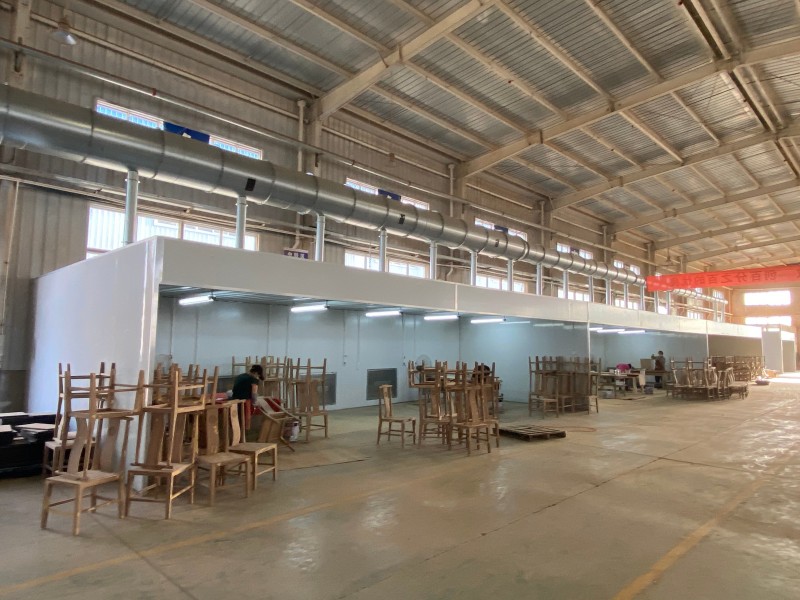
The LUFMAX Sanding Booth Solution:
Our Sanding Booths are engineered to capture fine particulates at the source before they ever enter the operator's breathing zone. Through optimized airflow patterns, we prevent dust blowback, maintaining a clear workspace and significantly improving operator comfort and focus. The compact, ergonomic design fits seamlessly into existing workshop layouts, freeing up floor space while reflecting a high standard of workplace management and professional brand image to your clients.
Applications of Sanding Booths in Furniture Manufacturing
| Application | Key Requirements |
|---|---|
| Cabinet door sanding | Working-area coverage for flat panels and profiled edges |
| Wooden furniture polishing | Effective collection during manual surface preparation |
| Solid wood component sanding | Filtration suitable for the generated wood dust |
| MDF and plywood finishing preparation | Dust capture and appropriate handling of fine engineered-wood particles |
| Primer sanding | Compatibility with the coating residue and dust characteristics |
| Custom furniture production | Flexible workstation configuration for varying workpiece sizes |
Where several sanding machines operate continuously across a large workshop, a centralized dust extraction system may be more appropriate than relying exclusively on individual booths. Equipment selection should reflect the number of workstations, production schedule and total airflow demand.
Sanding Booth vs. Centralized Dust Extraction System
Both localized sanding booths and centralized extraction systems can support dust management in woodworking facilities. Their suitability depends on the production layout and extraction requirements.
| Selection Factor | Sanding Booth | Centralized Dust Extraction System |
|---|---|---|
| Main application | Localized sanding and polishing tasks | Multiple dust-generating machines or production zones |
| Installation | Self-contained workstation | Shared filtration equipment connected through a duct network |
| Workstation arrangement | Dedicated working area | Extraction points distributed across the workshop |
| Space requirements | Requires floor space near the sanding operation | Requires space for the collector, ductwork and dust discharge |
| Suitable production pattern | Individual or localized surface-processing tasks | Multi-machine production and coordinated extraction demand |
| Maintenance | Filter and dust collection components at the workstation | Central filtration, ductwork, fans and dust discharge equipment |
For a dedicated polishing room, a sanding booth can provide localized collection without requiring every workstation to connect to a large central system. For a factory with many machines and continuous production, centralized extraction may offer a more suitable overall configuration.
Maintenance and Safety Considerations
Routine maintenance helps keep a sanding booth operating as intended. Inspection should cover the filter condition, airflow, dust drawer, extraction openings and automatic cleaning components where fitted.
Wood dust and some coating residues may present fire or combustible-dust hazards. The equipment configuration should therefore be evaluated according to the processed material, potential ignition sources and applicable safety requirements.
| Maintenance or Safety Item | Recommended Consideration |
|---|---|
| Filter cartridges | Inspect loading and replace according to the manufacturer's guidance |
| Airflow | Check extraction performance and investigate changes in suction |
| Dust drawers | Empty before excessive accumulation affects operation |
| Cleaning system | Verify the operation of automatic filter cleaning components |
| Process materials | Confirm compatibility with the filtration system and dust collection method |
| Fire and explosion protection | Assess the dust hazard and specify required protective measures |
| Workshop housekeeping | Prevent dust accumulation around the workstation and adjacent equipment |
The booth should be integrated into the workshop's overall dust control and safety procedures. Its presence alone does not guarantee compliance with every occupational exposure or combustible-dust requirement.
Customized Sanding Booths for Polishing Rooms
LUFMAX can evaluate sanding booth configurations according to the following application information.
| Parameter | Information Required |
|---|---|
| Workpiece type | Cabinet doors, furniture panels, solid wood components or other products |
| Maximum workpiece dimensions | Length, width, height and working clearance |
| Material | Solid wood, MDF, plywood, coated components or other materials |
| Processing method | Manual sanding, polishing, grinding or coating preparation |
| Dust characteristics | Particle type, dust loading and any relevant material hazards |
| Production requirements | Operating hours, number of operators and processing frequency |
| Booth configuration | Working-area dimensions, airflow arrangement and filter configuration |
| Workshop conditions | Available floor space, installation location and ventilation arrangements |
| Maintenance preferences | Filter access, dust drawer capacity and cleaning requirements |
| Additional safety requirements | Applicable workplace standards and any required protective equipment |
These details help determine whether a standalone sanding booth or a broader extraction system is better suited to the polishing room.
Discuss Your Polishing Room Dust Collection Requirements with LUFMAX
LUFMAX supplies downdraft sanding booths for furniture manufacturing, woodworking and other surface-processing applications that generate airborne dust.
Whether you are setting up a new polishing room or improving dust collection at an existing workstation, our team can assess your workpieces, sanding process, workshop layout and filtration requirements to recommend a suitable configuration.
-
Previous:
-
Next:
Latest News
-
Oct.12, 2026
Cabinet Dust Collector Review: Best Uses and Limitations
Are you a woodworker struggling with airborne dust particles that affect both your health and project quality? Enter the Lufmax cabinet dust collector. This innovative device is designed specifically for woodworking professionals and hobbyists who encounter excessive dust and debris during their activities. By providing a comprehensive solution to dust collection, the Lufmax ensures a cleaner
-
Oct.08, 2026
Pros and Cons of a Dry Spray Booth for Furniture Finishing
In today’s competitive furniture manufacturing landscape, the choice of finishing equipment significantly influences product quality and production efficiency. Many woodworkers and furniture manufacturers face challenges with traditional finishing methods, including prolonged drying times and inconsistent finishes, leading to high defect rates. A dry spray booth presents a solution that could
-
Sep.28, 2026
What Is a Water Wash Paint Booth and How Does It Work?
A water wash paint booth is an industrial system designed for the efficient and eco-friendly painting of various surfaces, primarily used in the automotive and manufacturing industries. Unlike traditional paint booths that rely on chemical solvents, a water wash paint booth utilizes water as the primary medium for capturing overspray and contaminants, ensuring a cleaner environment and higher